
The Complete Guide to Proper Exercise Form: Master Safe and Effective Movement Techniques
Proper exercise form is the single most important factor separating productive training from painful injuries. Whether you are picking up a barbell for the first time or refining a decade-long fitness routine, mastering safe movement mechanics protects your joints, maximizes muscle activation, and produces faster results. This guide covers everything you need to know about correct technique across major movement patterns, common form mistakes, and practical strategies for building good habits from day one.
Why Proper Form Matters More Than Weight or Reps
Many gym-goers prioritize lifting heavier or finishing more sets before they have mastered the foundational movement. This approach is one of the leading causes of preventable exercise-related injuries. According to the Centers for Disease Control and Prevention, physical activity is essential for long-term health, yet injuries from improper technique undermine those benefits by forcing people into extended rest periods.
Proper form accomplishes several things at once. It distributes load evenly across the intended muscle groups, reduces stress on vulnerable structures like the spine, knees, and shoulders, and trains your nervous system to recruit muscle fibers efficiently. A well-executed bodyweight squat trains the same neuromuscular pathways you will rely on when you eventually add weight. Skipping that foundation creates movement debt you will eventually have to repay.
The core principle is simple: form before load, always. If you cannot perform a movement cleanly without weight, adding resistance will only amplify the dysfunction.
Understanding the Five Fundamental Movement Patterns
Most exercises in any well-designed program are variations of five foundational movement patterns. Learning these patterns teaches your body to move safely in all exercise contexts and in everyday life.
1. The Squat Pattern
The squat is a fundamental human movement. Proper squat mechanics involve feet shoulder-width apart or slightly wider, toes turned out slightly to match your hip anatomy. As you descend, push your knees out in line with your toes, keep your chest tall, and maintain a neutral spine throughout the movement. Your weight should be distributed evenly through the full foot, not just the heels or toes.
Common mistakes include allowing the knees to cave inward, rounding the lower back at the bottom, or lifting the heels off the floor. Heel elevation often signals tight ankle mobility, which can be addressed with targeted stretching before loading the movement.
2. The Hinge Pattern
The hip hinge, seen in deadlifts, Romanian deadlifts, and kettlebell swings, is built on pushing the hips backward while maintaining a neutral spine. Think of the movement as closing a car door with your hips rather than bending forward with your back. Your hamstrings should feel a strong stretch at the bottom of a hinge, not compression in your lower back.
To practice the hinge, stand a few inches from a wall and push your hips back until they touch it, keeping your shins vertical and your back flat. This drill teaches the movement pattern before any external load is introduced.
3. The Push Pattern
Horizontal pushing (bench press, push-up) and vertical pushing (overhead press) both require stable shoulder blades and a strong midline. For horizontal pushes, retract and depress your scapulae before pressing. This protects the rotator cuff by ensuring the humerus moves in a mechanically advantageous position.
For overhead pressing, avoid excessive arching of the lower back by bracing your core and slightly tucking your ribs down. Flaring the elbows excessively during a bench press is a common error that shifts stress onto the anterior shoulder capsule rather than the chest and triceps.
4. The Pull Pattern
Rows and pull-ups belong to the pull category. The key cue here is to initiate the movement by squeezing your shoulder blades together and driving your elbows down and back, rather than pulling with your hands and biceps alone. This activates the larger latissimus dorsi and rhomboid muscles, which should bear the majority of the load.
5. The Carry and Core Pattern
Loaded carries, planks, and anti-rotation exercises train the core’s true function: resisting movement rather than generating it. A solid plank requires a straight line from head to heel, active glutes, and a braced midsection. Letting the hips sag or pike upward eliminates the training stimulus and puts unnecessary stress on the lumbar spine.
A Breakdown of Form Cues for Common Exercises
Generic advice only goes so far. Here is a practical reference for the most popular exercises performed in gyms and home settings.
| Exercise | Key Form Cues | Most Common Mistake | Primary Muscles Targeted |
|---|---|---|---|
| Back Squat | Neutral spine, knees tracking toes, chest tall, full foot contact | Knee cave and butt wink at depth | Quadriceps, glutes, hamstrings |
| Conventional Deadlift | Bar over mid-foot, hips hinge back, lats engaged, drive through the floor | Rounding the lower back on the pull | Hamstrings, glutes, erectors, traps |
| Bench Press | Scapulae retracted, slight arch, bar to lower chest, elbows at 45-75 degrees | Excessive elbow flare, loss of scapular retraction | Pectorals, triceps, anterior deltoid |
| Overhead Press | Ribs down, core braced, bar travels in straight vertical line | Lumbar hyperextension, forward bar path | Deltoids, triceps, upper traps |
| Pull-Up / Chin-Up | Full hang start, depress scapulae first, chin over bar, control the descent | Kipping without strength base, partial range of motion | Latissimus dorsi, biceps, rear deltoids |
| Barbell Row | Hip hinge position, bar to lower ribs, elbows drive back | Using momentum, jerking the torso upright | Rhomboids, lats, rear deltoids, biceps |
| Romanian Deadlift | Soft knee bend, hips push back, bar stays close to legs, hamstring stretch | Bending knees too much, losing spinal neutrality | Hamstrings, glutes, erectors |
| Plank | Straight line from head to heel, active glutes, forearms shoulder-width, neutral neck | Hips sagging or piking, holding breath | Transverse abdominis, obliques, glutes |
The Role of Mobility and Flexibility in Form
Poor form is often a symptom of limited mobility rather than carelessness. If your thoracic spine (mid-back) is stiff, you will struggle to keep an upright torso in an overhead press. If your hip flexors are chronically tight from sitting, your squat will involve compensations that load your lower back instead of your glutes and quads.
The American College of Sports Medicine recommends flexibility training as a core component of a balanced fitness program, noting that adequate range of motion supports both performance and injury prevention.
Incorporating a five to ten minute mobility routine before training sessions pays dividends quickly. Focus on the areas most relevant to your session: hip flexors and ankles before squats and deadlifts, thoracic spine and shoulder external rotation before overhead and pressing movements. Tools like foam rollers and lacrosse balls can address myofascial restrictions that limit range of motion.
One highly regarded resource for mobility work is the movement screening protocol developed by the Functional Movement Systems team, which identifies mobility and stability asymmetries before they become injuries.
How to Self-Assess and Correct Your Form
You do not need a personal trainer present every session to monitor your technique, though working with one initially is highly valuable. Here are practical strategies for ongoing self-assessment.
Use Video Recording
Recording yourself from the side and front during working sets provides objective feedback that mirrors and real-time perception cannot. Most form errors are invisible to the lifter because proprioception, the body’s sense of its own position, can be inaccurate when movement patterns are still being learned. Review footage immediately after a set while the feeling of the movement is still fresh.
Work With a Qualified Coach
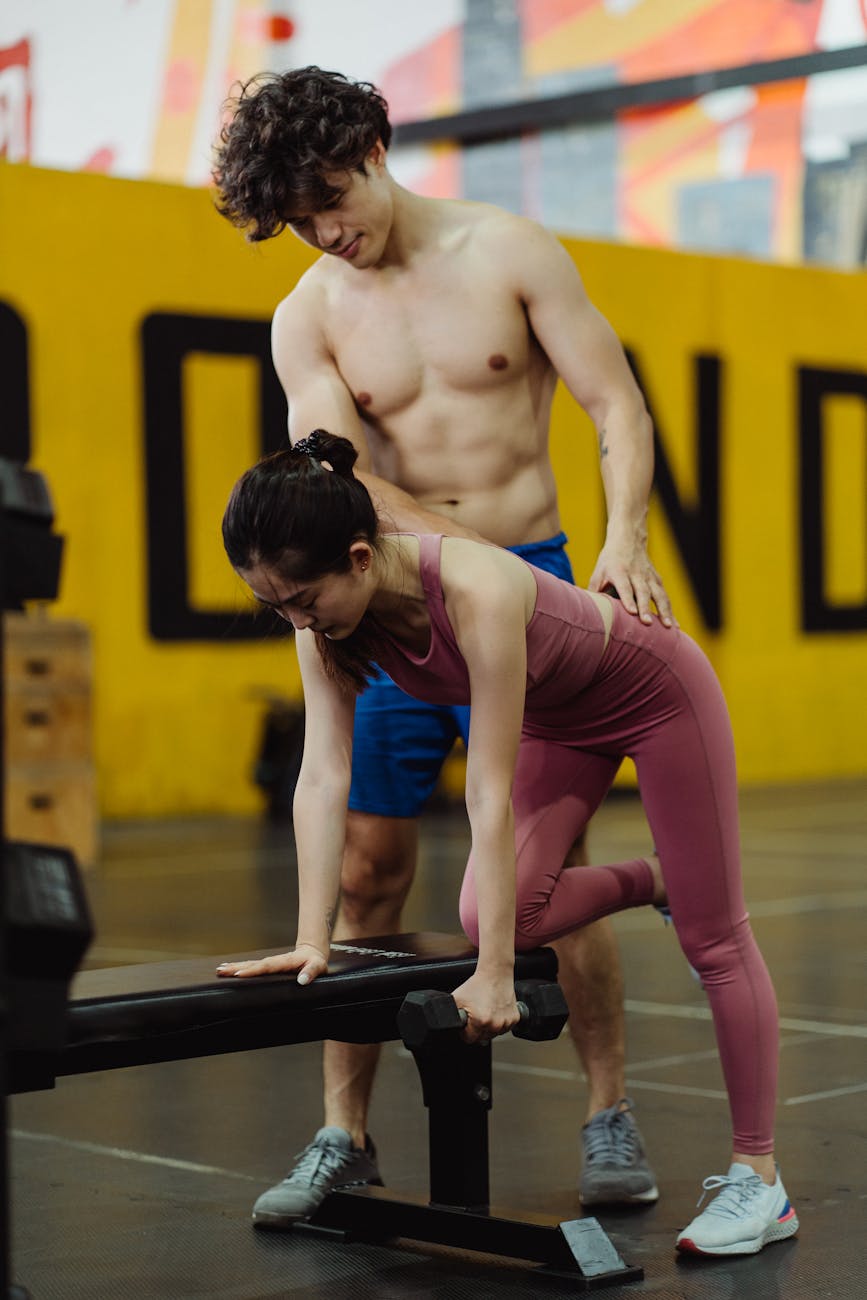
A certified personal trainer or strength coach can identify compensations in a single session that might take months to discover on your own. Look for certifications from recognized bodies. The National Academy of Sports Medicine (NASM) and the National Strength and Conditioning Association (NSCA) both certify coaches to assess movement and program corrective exercise.
Use the Pause and Feel Method
At the bottom or end range of a movement, pause for one to two seconds and do a quick internal check. Are your knees in the right position? Is your lower back neutral or rounded? Is the tension in the right muscle group? This method slows the movement enough to build genuine proprioceptive awareness over time.
Regress Before You Progress
If form breaks down, reduce the weight or regress to an easier variation. A goblet squat is an excellent regression for the back squat because the counterbalance naturally encourages an upright torso and proper depth. A resistance band pull-apart is a regression that teaches scapular retraction before loading it in a row.
Breathing and Bracing: The Overlooked Foundation
Many lifters focus entirely on limb position and ignore the internal pressure mechanics that make safe lifting possible. The Valsalva maneuver, which involves taking a deep breath into the belly, bracing the abdominals hard, and holding that pressure during the effort phase of a lift, creates intra-abdominal pressure that stabilizes the spine under load.
For lighter exercises and aerobic activity, normal breathing rhythm is fine. For heavy compound lifts like squats and deadlifts, proper bracing mechanics are protective and performance-enhancing. The key is to breathe in at the top of the movement before descending, brace hard, complete the rep, and reset at the top.
For exercises like planks, rows, and presses at moderate loads, a more rhythmic approach works well: exhale during the effort phase (the pull or push) and inhale on the return. What you want to avoid is holding your breath without bracing or breathing too shallowly, both of which remove spinal support at critical moments.
Progressing Safely: The 10 Percent Principle and Beyond
One of the most widely cited guidelines in sports medicine is the general principle of not increasing training volume or intensity by more than roughly 10 percent per week, which helps prevent overuse injuries as the body adapts. The U.S. Department of Health and Human Services and sports medicine organizations broadly support gradual progression as a cornerstone of injury prevention.
In practical terms, this means:
- Add weight in small increments. For upper body lifts, 2.5 kg jumps are often more appropriate than 5 kg jumps. For lower body, 5 kg increments are reasonable once the movement is solid.
- Prioritize technical quality over numerical milestones. A heavier lift with broken form is not a true personal record.
- Deload every four to six weeks by reducing volume or intensity. This allows connective tissue and the nervous system to recover and adapt fully.
- Track your sessions so you can identify patterns, such as form degrading when fatigue accumulates over several weeks of hard training.
Building a Form-First Training Culture
Individual technique is important, but the training environment shapes habits powerfully. If you train in a setting where heavy lifting is celebrated and form is ignored, you will face constant pressure to prioritize weight over mechanics.
Seek out environments and communities that value quality movement. This might mean finding a gym with knowledgeable coaching staff, joining an online community focused on technical development, or working with a program designed around progressive skill building rather than just progressive overload.
Programs built on these principles, such as those offered through Stronger By Science, prioritize education alongside programming. Understanding the why behind each cue helps you internalize correct movement far faster than following instructions blindly.
Frequently Asked Questions About Exercise Form
How long does it take to develop proper exercise form?
The timeline varies based on the complexity of the movement, your prior athletic experience, and how consistently you practice. Simple movements like a plank or goblet squat can be learned with solid mechanics in a few sessions. Complex compound lifts like the Olympic snatch may take months to years to refine. For most common gym exercises, consistent practice over four to eight weeks produces meaningful improvement in movement quality. The key variable is deliberate attention during every rep, not just total time spent.
Is it safe to learn form from YouTube videos?
YouTube is a genuinely useful resource when you rely on credible channels run by certified coaches or sports scientists. The limitation is that video instruction cannot observe your individual movement and provide corrective feedback. Use videos to understand concepts and cues, then use your own recordings and occasional in-person coaching to apply them correctly to your body. Not all popular fitness channels are run by qualified professionals, so verify credentials before treating advice as authoritative.
Should I prioritize form over a full range of motion?
These two goals are not in conflict. Good form includes using the appropriate range of motion for your anatomy and mobility. However, forcing range of motion beyond what your current mobility allows will compromise form. The practical approach is to train through the range of motion you can currently control with good technique, and work on mobility separately to expand that range over time. A shallow squat with a perfect spine is preferable to a deep squat with rounding and knee cave.
What should I do if I feel pain during an exercise?
Stop the exercise immediately. Pain during training is not a form cue to push through. Sharp, joint-based, or stabbing pain in particular signals that something is wrong mechanically or structurally. Mild muscular discomfort and the burn of fatigue are normal. Pain that persists between sessions, radiates, or is localized to a joint warrants evaluation by a qualified healthcare professional such as a sports medicine physician or physical therapist. Training through pain without diagnosis typically converts a minor issue into a serious one.
Can I build a strong body training at home without gym equipment?
Absolutely. Bodyweight exercises performed with excellent form produce substantial strength and hypertrophy gains, particularly for beginners and intermediates. The form principles are identical whether you are doing a bodyweight squat or a barbell back squat. In fact, mastering bodyweight movement patterns before adding load is an ideal progression sequence. Resistance bands and adjustable dumbbells expand the range of available exercises considerably and are practical investments for home training.
Summary: The Non-Negotiables of Good Exercise Form
Mastering proper exercise form is not a beginner concern that experienced lifters move past. It is an ongoing practice that scales with your training age and the complexity of movements you pursue. The foundations never change, regardless of how advanced you become.
Keep these principles at the center of every session:
- Form before load. Establish clean mechanics before adding weight or intensity.
- Neutral spine during loaded movements. Protect your intervertebral discs and surrounding structures by avoiding excessive flexion or extension under load.
- Brace and breathe with intention. Intra-abdominal pressure is your internal weight belt.
- Record and review regularly. Objective video feedback outperforms subjective feel every time.
- Address mobility restrictions proactively. Tight tissue creates compensations that compound over time.
- Progress gradually and track your training. Steady, documented progress is the safest and most sustainable path forward.
Consistent attention to these fundamentals transforms exercise from a risk into one of the most powerful health investments you can make. The goal is not perfection on every rep, but steady improvement and honest self-assessment over the long term.